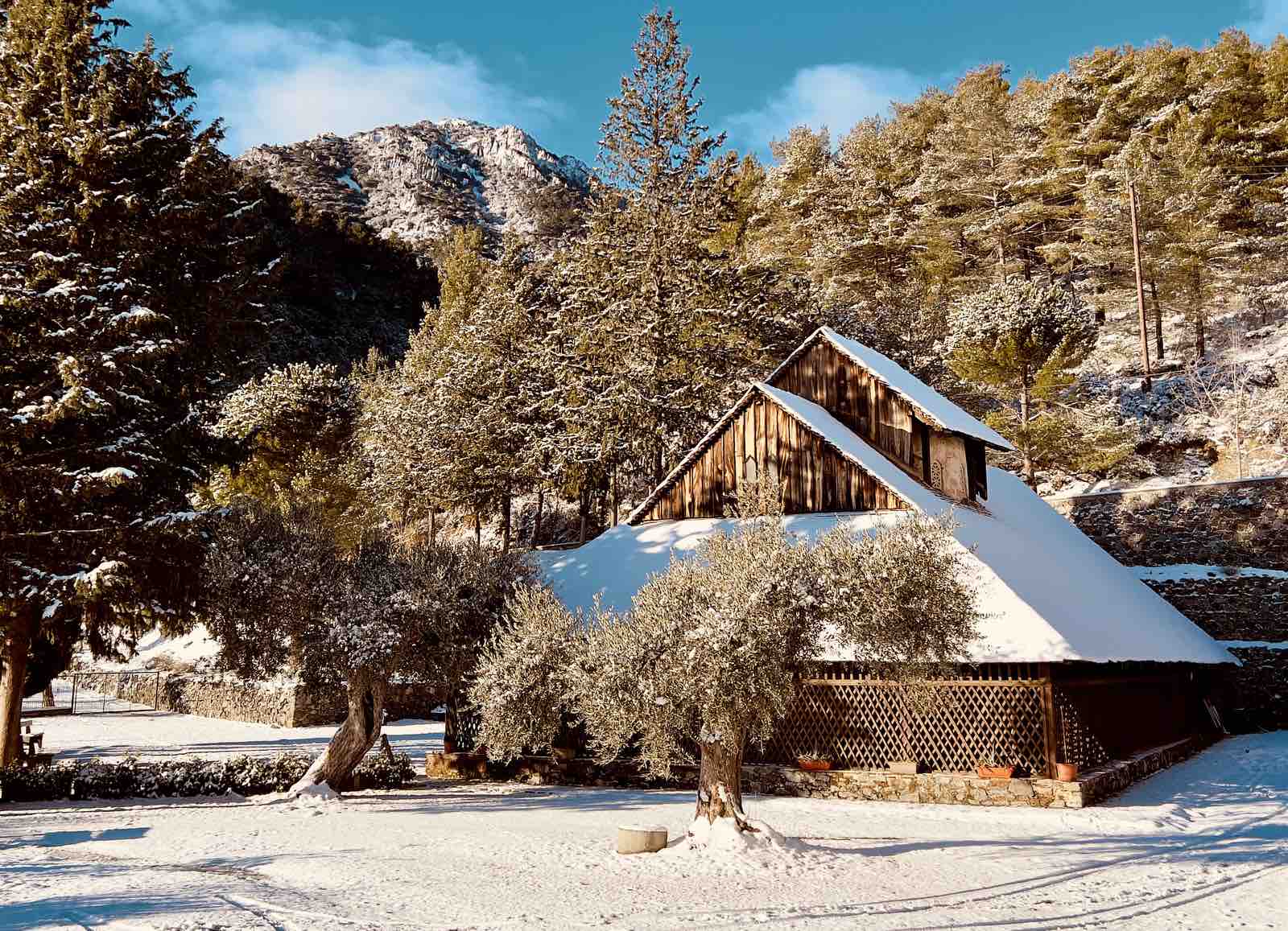
From the monastery of St Herakleidios, first bishop of Tamassos, to the painted churches of Pitsilia: Stavros tou Ayiasmati, Panagia tou Araka and Panagia Chrysokourdaliotissa.
This route starts a few kilometres outside Nicosia and climbs into the eastern Troodos. At its start is one of the island's oldest Christian memories: the place of St Herakleidios, who by tradition was ordained first bishop of Tamassos by the Apostles Paul and Barnabas. At its end are two of the Pitsilia churches on UNESCO's World Heritage List: Panagia tou Araka, with frescoes completed in 1192, and Stavros tou Ayiasmati, with the most complete set of late 15th-century wall paintings in Cyprus. Together with Panagia Chrysokourdaliotissa, which Cyprus has proposed as an extension of the same UNESCO site, the day traces how church painting changed from the late Komnenian period to the 16th century.
The route
The monastery of Ayios Herakleidios lies among the olive groves of Politiko, where ancient Tamassos stood. From there the road climbs south-west into the hill country of Pitsilia. Stavros tou Ayiasmati stands alone in the countryside, about three kilometres outside Platanistasa. Panagia tou Araka is near Lagoudera, on the north-eastern slopes of Madari. The last stop, Panagia Chrysokourdaliotissa at Kourdali, is a little further west, towards the Solea valley, and from there you can return to Nicosia through Solea. The Pitsilia roads are narrow and winding, so allow plenty of time.
Practical notes
- Stavros tou Ayiasmati is opened by appointment with the priest of Platanistasa. At Panagia tou Araka the priest usually lives beside the church and opens it for visitors. The Deputy Ministry of Tourism (visitcyprus.com) lists the contact numbers and notes that hours may change, so phone ahead.
- Ask before photographing the frescoes.
- Ayios Herakleidios is a convent and keeps its feast on 17 September. In August 2026 conservation works with the Department of Antiquities were reported there, expected to finish by the end of the year.
- Pitsilia has more UNESCO churches that are not on this route: Timios Stavros at Pelendri and Ayia Sotira at Palaichori.
Sources
- Wikipedia (en) – Panagia tou Araka (en.wikipedia.org) · CC BY-SA 4.0
- Wikipedia (en) – Painted Churches in the Troödos Region (en.wikipedia.org) · CC BY-SA 4.0
- Holy Metropolis of Tamassos and Oreini – Monastery of Ayios Herakleidios (imtamasou.org.cy)
- Visit Cyprus – Timios Stavros tou Agiasmati Church (visitcyprus.com)
- Visit Cyprus – Panagia tou Araka Church (visitcyprus.com)
- UNESCO – Tentative List: Church of Panayia Chrysokourdaliotissa (whc.unesco.org)
- Cyprus Mail – Ayios Irakleidios restoration due this year (2026) (cyprus-mail.com)
- Lonely Planet – Monastery of Agios Irakleidios (lonelyplanet.com)
The route
Driving: ≈ 1 h 25 min · 55 kmFrom the first stop to the last, not counting the visits; an estimate without traffic (OpenStreetMap).
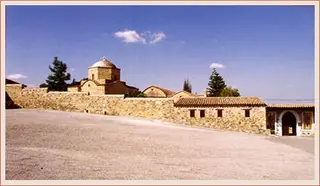 1MonasteryΙερά Μονή Αγίου ΗρακλειδίουPolitikoA convent on the site of ancient Tamassos. By tradition St Herakleidios guided the Apostles Paul and Barnabas in Cyprus and was ordained by them bishop of Tamassos. His skull is kept in a reliquary in the church.
≈ 40 min · 31 km to the next stop
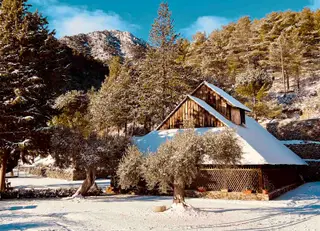
- 2MonasteryΙερά Μονή Τιμίου Σταυρού του ΑγιασμάτιPlatanistasaIts decoration was finished in 1494, and an inscription names the painter as Philippos Goul. The donors, the priest Petros Peratis and his wife Pepani, offer a model of the church to Christ. A portico running round all four sides is found in no other church in Cyprus.
≈ 14 min · 11 km to the next stop
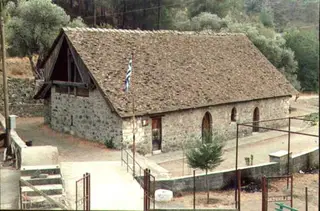
 3MonasteryΙερά Μονή Παναγίας του ΆρακαLagouderaAn inscription on the north lintel dates the frescoes to December 1192. They are attributed to Theodore Apsevdis, a painter trained in Constantinople. Look for the Panagia Arakiotissa, flanked by angels holding the instruments of the Passion.
≈ 29 min · 13 km to the next stop
 4ChurchΙερός Ναός Καθολικό Ιεράς Μονής Παναγίας ΧρυσοκουρδαλιώτισσαςKourdaliA 16th-century monastery church with Italo-Byzantine wall paintings and icons and a carved iconostasis of the 16th–17th century. Since 2002 it has been on UNESCO's Tentative List as a proposed extension of the Troodos painted churches.