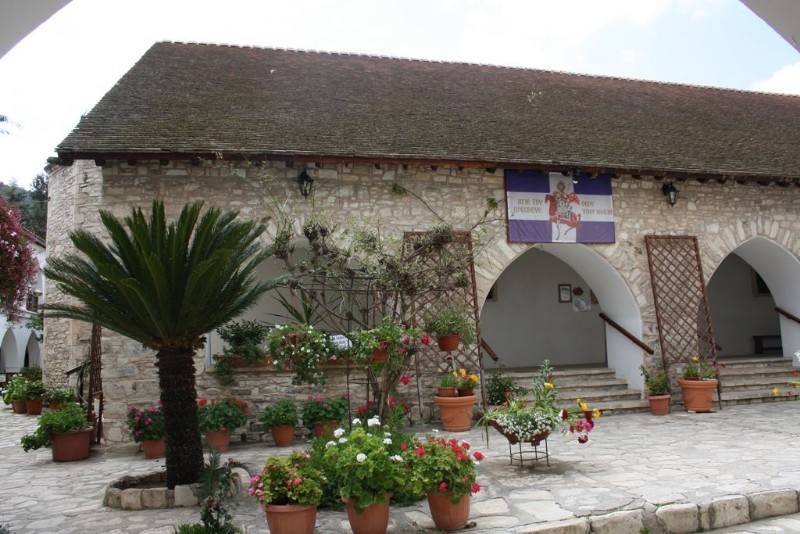
A quiet route through the hills of Larnaca district: Ayia Thekla at Mosfiloti, the Holy Cross and the Archangel at Lefkara, Kato Drys, birthplace of St Neophytos, and the convent of Ayios Minas at Vavla.
Between Nicosia, Larnaca and Limassol, in the first foothills of the Troodos, the villages around Lefkara keep an old and living church tradition. This route links two working convents, Ayia Thekla and Ayios Minas, with three stops in Lefkara and Kato Drys. At Lefkara the church of the Holy Cross keeps a cross believed to contain a piece of the True Cross. In the lower village, local tradition holds that the small church of the Archangel Michael is all that remains of a medieval monastery. Kato Drys is the birthplace of St Neophytos the Recluse, one of the best-loved saints of Cyprus. Distances are short, so the route fits easily into a morning, or into an unhurried day with a walk through the lanes of Lefkara.
The route
Leaving the Nicosia–Limassol motorway, the first stop is the convent of Ayia Thekla, about half a kilometre south of Mosfiloti. The road then heads south to Lefkara, for Timios Stavros in the upper village and the Archangel Michael in Kato Lefkara. From there you pass through Kato Drys and end at the convent of Ayios Minas near Vavla. If you have time, you can return by way of Larnaca and visit the church of Ayios Lazaros.
Practical notes
- Both monasteries are convents. Ayios Minas receives visitors at set hours with a midday break, and modest dress is required to enter the church. Hours change with the season, so check them before you go (visitcyprus.com and the website of the Metropolis of Trimythous).
- The nuns of Ayios Minas paint icons and sell them, along with fruit and home-made preserves.
- Ayia Thekla keeps its feast on 24 September and the Holy Cross at Lefkara on 14 September.
- Small chapels such as the Archangel at Kato Lefkara are not always open. Ask in the village.
Sources
- Holy Metropolis of Trimythous – Monastery of Saint Thekla (churches.imtrimythountos.org.cy)
- Mosfiloti Community – Holy Monastery of Ayia Thekla (mosfiloti.org)
- Larnaka Region – Timios Stavros (Holy Cross), Lefkara (larnakaregion.com)
- Cyprus Alive – Monastery of Timios Stavros, Lefkara (cyprusalive.com)
- International Byzantine Christian Art (King's College London) – Archangel Michael, Kato Lefkara (ibcc.dighum.kcl.ac.uk)
- Wikipedia (en) – Neophytos the Recluse (en.wikipedia.org) · CC BY-SA 4.0
- Visit Cyprus – Agios Minas Convent (visitcyprus.com)
- Cyprus Alive – The Monastery of Ayios Minas (cyprusalive.com)
The route
Driving: ≈ 45 min · 33 kmFrom the first stop to the last, not counting the visits; an estimate without traffic (OpenStreetMap).
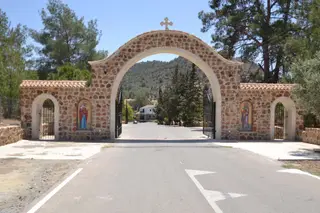 1MonasteryΙερά Μονή Αγίας ΘέκληςMosfilotiTradition says St Helena prayed here, water sprang up, and she built a church in honour of St Thecla. The holy spring still flows. An inscription over the north door records the rebuilding of the church in 1744 and its consecration in 1745. Today it is a convent.
≈ 23 min · 20 km to the next stop
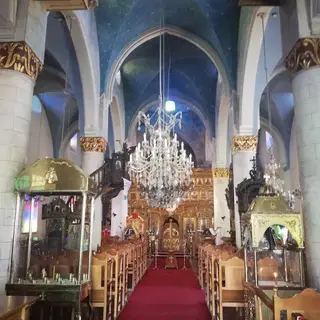 2ChurchΙερός Ναός Τιμίου ΣταυρούLefkaraThe east end of the church is medieval; the west part was replaced in 1867 by a three-aisled basilica. The church keeps a silver-gilt cross believed to hold a relic of the True Cross, with a verse inscription naming Olivianos, bishop of Lefkara in the early 14th century.
≈ 5 min · 2.8 km to the next stop
- 3ChapelΕξωκλήσι ΑρχαγγέλωνKato LefkaraA small single-aisled, cross-shaped church with a dome; its decoration is dated to the late 12th century. The apse shows the Communion of the Apostles. Local tradition holds that it is all that remains of the monastery of the Asomatos.
≈ 7 min · 4.3 km to the next stop
- 4ChapelΕξωκλήσι Αγίου ΝεοφύτουKato DrysKato Drys is the birthplace of St Neophytos the Recluse (1134–1214), who in 1159 settled in a cave in the hills above Paphos and founded his Enkleistra there. The village chapel is dedicated to him.
≈ 10 min · 6.0 km to the next stop
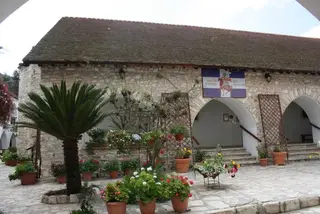 5MonasteryΙερά Μονή Αγίου ΜηνάVavlaThe first written record of the monastery dates from 1562. It was renewed in 1754, and two large wall paintings of St George and St Minas, dated 1757, survive on the north and south walls. The church combines Byzantine and Gothic features. It has been a convent since 1965.