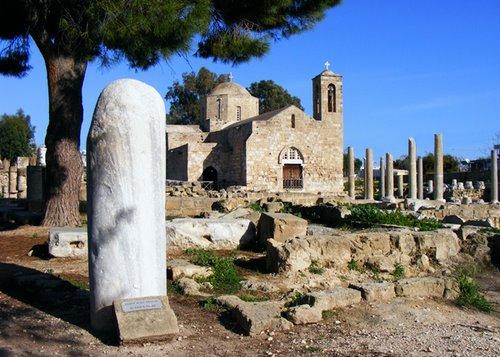
From the Byzantine church of Ayia Paraskevi at Geroskipou and St Paul's Kato Paphos to Panagia Chryseleousa at Emba and the monastery of Chrysorrogiatissa high in the hills.
Paphos is one of the places where the Christian history of Cyprus is easiest to see. In Kato Paphos, beside the ruins of the largest Early Christian basilica on the island, tradition points to 'St Paul's Pillar'. A little to the east, at Geroskipou, Ayia Paraskevi is one of only two five-domed basilicas in Cyprus. The route then heads north to Panagia Chryseleousa at Emba, with wall paintings from the 12th to the 16th century, and ends high in the hills at the monastery of Panagia Chrysorrogiatissa. In one day you move from town to countryside, and from the Early Christian centuries to monastic life today.
The route
Start at Geroskipou, about three kilometres east of Paphos, with Ayia Paraskevi. Continue to Kato Paphos for Ayia Kyriaki (Chrysopolitissa) and its excavated basilica. A short distance away is Panagia Theoskepasti, on a rock near the sea. Then drive north to Emba for Panagia Chryseleousa. End the day at Chrysorrogiatissa, a kilometre and a half from the village of Panagia, birthplace of Archbishop Makarios III. The last road is a mountain road, so allow time for it. For a detour, the Enkleistra of St Neophytos, the cave the saint made his home in 1159, lies in the hills above Paphos, not far from Emba.
Practical notes
- Ayia Paraskevi at Geroskipou keeps weekday hours, and Sunday visits need to be arranged in advance. Check visitcyprus.com before you go, because the hours may change.
- Ayia Kyriaki is also used for worship by the Catholic and Anglican communities of Paphos. Please respect services when they are taking place.
- Kato Paphos is hot and busy in summer. Mornings suit the town sites best, and you can leave the drive into the hills for the afternoon.
- Chrysorrogiatissa is known for its winery, but it is a monastery first, so dress modestly.
Sources
- Visit Cyprus – Agia Paraskevi Byzantine Church, Geroskipou (visitcyprus.com)
- Visit Cyprus – Early Christian Basilica, St Paul's Pillar, Chrysopolitissa / Agia Kyriaki (visitcyprus.com)
- Anglican Church of Paphos (Revd Paul Carr) – Agia Kyriaki (revpacman.com)
- Wikipedia (en) – Church of Panagia Theoskepasti (en.wikipedia.org) · CC BY-SA 4.0
- Wikipedia (en) – Empa, Cyprus (en.wikipedia.org) · CC BY-SA 4.0
- Visit Cyprus – Panagia Chryseleousa Church (visitcyprus.com)
- Wikipedia (en) – Chrysoroyiatissa Monastery (en.wikipedia.org) · CC BY-SA 4.0
- Visit Cyprus – Chrysorrogiatissa Monastery (visitcyprus.com)
- Wikipedia (en) – Neophytos the Recluse (en.wikipedia.org) · CC BY-SA 4.0
The route
Driving: ≈ 1 h 10 min · 46 kmFrom the first stop to the last, not counting the visits; an estimate without traffic (OpenStreetMap).
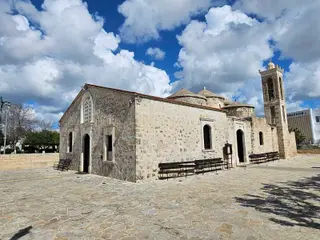 1ChurchΙερός Ναός Αγίας ΠαρασκευήςGeroskipouA three-aisled basilica with five domes set in a cross, one of only two of its kind in Cyprus. A plain red cross painted straight onto the stone is among the oldest parts of the decoration. The church keeps a 15th-century double-sided icon: the Virgin on one face, the Crucifixion on the other.
≈ 11 min · 5.6 km to the next stop
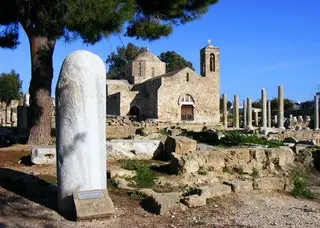 2ChurchΙερός Ναός Αγίας ΚυριακήςKato PafosBuilt over the ruins of the largest Early Christian basilica in Cyprus, first seven-aisled and later reduced to five, whose mosaic floors partly survive. Within the enclosure is the column where, by tradition, the Apostle Paul was scourged.
Very close — on foot
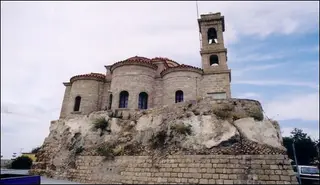 3ChurchΙερός Ναός Παναγίας ΘεοσκεπάστηςKato PafosTradition says that when Arab raiders approached, God veiled the church in mist and it was saved, hence 'Theoskepasti', 'veiled by God'. The present church was built in the 1920s on the Byzantine foundations. It keeps a silver-covered icon of the Virgin that tradition ascribes to St Luke.
≈ 12 min · 6.4 km to the next stop
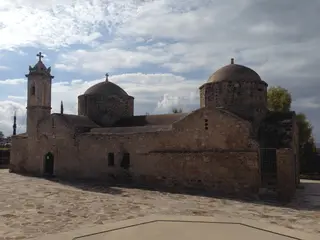 4ChurchΙερός Ναός Παναγίας ΧρυσελεούσηςEmpaThe east part was built in the 12th century as a cross-shaped church with a dome. A second domed church was added to the west in the 13th century, so the church now has two domes. Wall paintings of the 12th, 13th, 15th and 16th centuries survive.
≈ 50 min · 34 km to the next stop
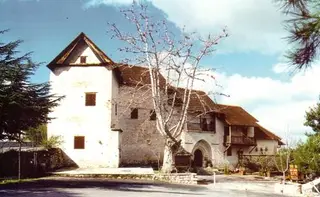 5MonasteryΙερά Μονή ΧρυσορροϊατίσσηςBy tradition it was founded in 1152 by the monk Ignatius to house an icon of the Virgin ascribed to St Luke. The present buildings date from 1770. The monastery lies a kilometre and a half from Panagia, the birthplace of Archbishop Makarios III.