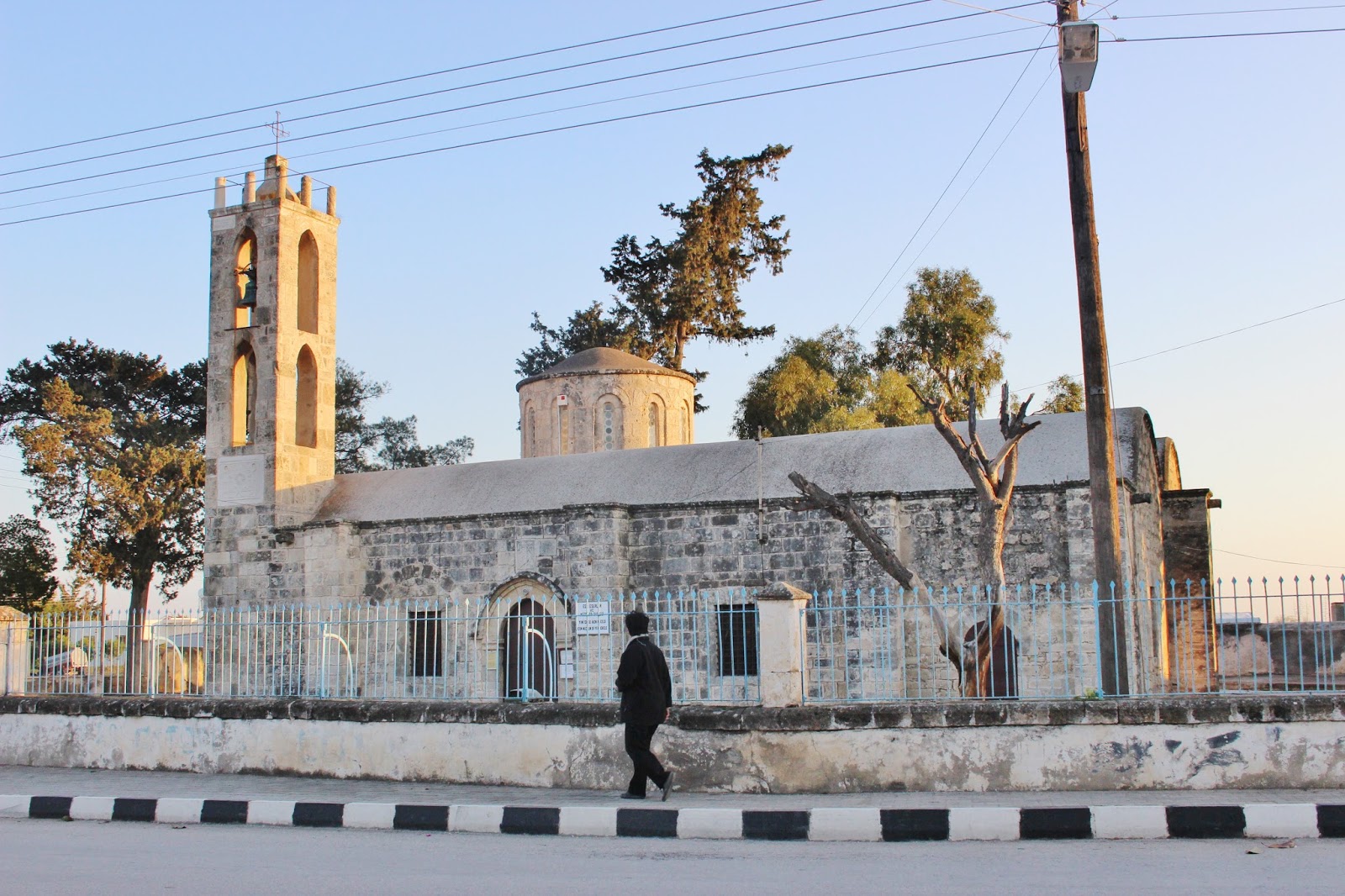
One of the most important medieval ecclesiastical monuments of the area: a Byzantine domed core with early-12th-century wall paintings and a Gothic addition of the Frankish period.
The Church of Panagia Theotokos stands in Trikomo, Famagusta District, in the occupied part of the Republic of Cyprus. It is one of the most important medieval ecclesiastical monuments of the area and a particularly significant example of Byzantine architecture and painting in Cyprus. The Church of Cyprus officially records Panagia Theotokos among the occupied Christian monuments of Trikomo.
History and dating
The original Byzantine core of the church dates to the early 12th century or slightly earlier. Its surviving wall paintings are securely associated with the early 12th century, indicating that the building itself was already standing by that time. Scholarly research has repeatedly linked the Trikomo paintings with the major Byzantine ensembles at Panagia Phorviotissa at Asinou and the Monastery of Saint John Chrysostomos at Koutsovendis.
The building did not retain its original form unchanged. During the Frankish period, probably in the 15th century, another section with Western Gothic characteristics was added to the Byzantine church. The monument consequently became an important example of the interaction between Byzantine Orthodox and Latin Western architectural and artistic traditions in medieval Cyprus.
Architecture
The older section is a Byzantine domed church. Its eastern termination is especially interesting, and architectural scholarship cites Panagia Theotokos at Trikomo as an example of a Cypriot church with a double-apse arrangement, contrasting with the triple-apse plans found in several earlier Cypriot churches.
The later addition displays Gothic features associated with the Latin architectural tradition of Frankish Cyprus. The resulting structure preserves several historical phases within a single monument. Rounded apses, narrow arched openings, the dome and the later tall bell tower remain prominent elements of its present appearance.
The 12th-century wall paintings
The greatest artistic importance of the church lies in its surviving Byzantine wall paintings. The frescoes of Panagia Theotokos are regarded in scholarship as among the finest examples of Early Komnenian painting in Cyprus. Researchers have noted close stylistic relationships with the paintings of Panagia Phorviotissa at Asinou, dated to 1105/1106, and those of Saint John Chrysostomos at Koutsovendis. David Winfield argued for a close artistic relationship among the painters responsible for these monuments.
The iconographic programme includes episodes from the lives of the Virgin Mary and Christ. Recorded scenes include subjects connected with the Nativity of the Virgin, her parents Joachim and Anna, and other Christological and Marian themes. The paintings are particularly valued for their vitality, colour and expressive treatment of the figures.
An important eschatological composition involving the Hetoimasia, or Prepared Throne, has also received scholarly attention. It forms part of a complex programme involving angelic processions and the figures of the Virgin and Saint John the Baptist, demonstrating the theological richness of the church's original decoration.
Later paintings and Latin influences
The later section also preserves 15th-century paintings. These are significant because they reflect the coexistence and interaction of Byzantine and Western artistic traditions during the Frankish period. Several figures of martyrs and saints survive, although some are heavily damaged and not all identifications are certain.
The monument therefore preserves two particularly important artistic layers: outstanding Byzantine painting of the early 12th century and later evidence of the complex artistic environment of Cyprus under Latin rule.
Trikomo and the situation after 1974
Trikomo lies approximately 20 km north of Famagusta, between the Mesaoria plain and the beginning of the Karpas Peninsula. Before the Turkish invasion of 1974 it was a large Greek Cypriot community of Famagusta District. The historical record reproduced by Biodiversity of Cyprus gives a 1960 population of 2,188 Greek Cypriots and 7 Turkish Cypriots. By 1979 only 22 Greek Cypriots remained under very difficult conditions, and they were subsequently displaced.
Following the Turkish invasion and continuing occupation of the northern part of the Republic of Cyprus, the church ceased to function normally as an Orthodox place of worship. It was later converted into a display space for religious icons and ecclesiastical objects. Sources operating under the occupation administration state that it became an “Icon Museum” in 1991, containing icons, wooden carvings and liturgical objects gathered from the wider region. This describes the building's present use and does not alter its historical identity as the Orthodox Church of Panagia Theotokos.
Historical and artistic significance
Panagia Theotokos at Trikomo is of exceptional importance to the history of Cypriot art. Its Byzantine architectural core, major early-12th-century paintings, close artistic connections with Asinou and Koutsovendis, and subsequent Gothic and painted additions of the Frankish period preserve several centuries of the religious and artistic history of Cyprus within a single monument.
Text and photos: George Konstantinou – Trikomo, 17 February 2016
ფოტოები
წყაროები
- Biodiversity of Cyprus – Church of Panagia Theotokos in occupied Trikomo (biodiversitycyprus.blogspot.com). Original photographic record, 17 February 2016.
- Church of Cyprus – Christian monuments and list of occupied churches.
- Winfield, D. C. (1972), “Hagios Chrysostomos, Trikomo, Asinou: Byzantine Painters at Work”, Proceedings of the First International Cyprological Congress, vol. II, pp. 285–291.
- Stylianou, A. & Stylianou, J. A., The Painted Churches of Cyprus: Treasures of Byzantine Art.